

Sunday Bible Study/Confirmation - Can a child have faith?
/How does the Bible talk about believing and trusting God's promises?
Growing is something that can be done both individually as well as in a group. In fact, we need to learn in both ways. This group meets after worship and a brief fellowship time on Sundays.
This is led by Pastor Ben who has great passion for education and allowing God’s Word to teach us. There have been a wide range of topics discussed in this class and is for all levels of familiarity with God’s Word. Sometimes we will delve into the readings from worship a little more to ask questions or confront our misconceptions due to a lack of familiarity with what it looked like to live in the ancient near east. Other times we discuss current life issues and how we as Christians are to relate to a world that doesn’t have the same way of viewing the world.
How does the Bible talk about believing and trusting God's promises?
The Christian confession is not: “Everything is getting better.” It is: “Christ has overcome.” It is not: “I can always see where God is leading me.” It is: “I know the One who is leading me.” It is not: “Darkness isn't real.” It is: “Darkness is real, but it does not have the final word.”
First we need to establish the need for baptism. Many people start with Mattthew 28 and the Great Commission. However, the case can be made well before this in the Old Testament and other texts. First we will explore Psalm 51, Jeremiah 1, Colossians 2, Romans 6, and more!
Setting the groundwork for why we have a catechism and the significance of Confirmation as a whole.
Why Do We Need a Catechism If We Have the Bible?
The catechism does not compete with the Bible. It teaches us to speak back what God has taught us in His Word.
As you read through this chapter consider also the full armor of God (Ephesians 6:13-18). How do you rest in your armor? How do you live in your armor?
Whether or not this chapter has changed your perspective of these Biblical characters, how do you see your own story differently? What does it mean for it to be said of you "when I am weak, then I am strong" (2 Corinthians 12:10)?
The author really challenges us to think outside of the box on how best to care for people. God’s unseen altars also challenge us to look beyond the walls of our sanctuary.
If God is anything, he is a God who has a thing for the normal. He is a God who turns our every expectation inside out.
The Scriptures are packed with illustrations of this tendency. To begin with, God goes out of his way to handpick the wrong people for his most important missions. Read Isaiah 53:2 and consider how God views “majesty” and “beauty” compared to your evaluation of those two attributes.
This book will embrace a veiled spirituality that discovers God rolling up his sleeves in the toy-strewn family rooms of stay-at-home moms, the dirty cabs of John Deere tractors, and the mop rooms of school janitors., where saints are forged in the fires of lives no one will remember except God.
While Pastor Ben was at the Pre-Lenten sermon writing conference this week in St. George, Utah, he had the privilege to enjoy some wonderful conversations. An interesting discussion came up in response to John 7:8, after reading this what do you think of John 7:10? Read the ESV translation first, then the KJV or NIV. Is there a problem?
How do we take Jesus comment to his mother, Mary? This text forces us to interact with Jesus’ two natures (100% Divine and 100% Human). It raises questions that are good for us to delve into and equally important for us to leave unanswered.
We know the Matthew text quite well (Matthew 1:18-25) but we are less familiar with Isaiah 7:10-17. There might be some low hanging fruit in the connections between the two, but dig a little deeper. What do you find?
Part IV will be uploaded shortly.
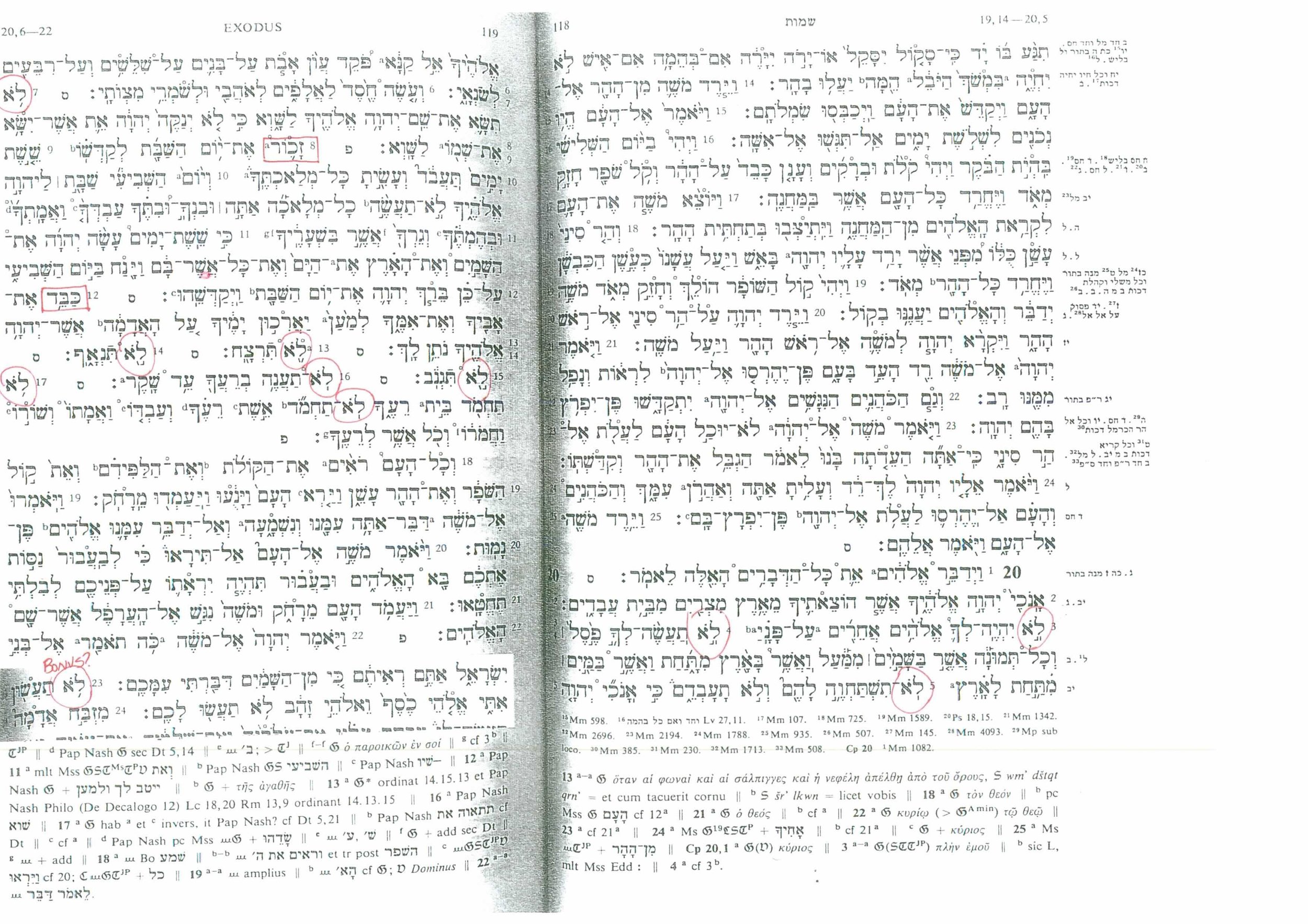
Many Christians are surprised to find out that there are more than one number of the ten commandments. This is not intended to be an exhaustive treatment of the ten commandments, but a chance to look at a few things in particular that are 1) misconceptions about the commandments and 2) have a better appreciation for why God would give us such a complex set of imperative commands.
For more information on the resources used in this discussion please contact Pastor Ben.